Paris Syndrome and Other Travel Phenomena You Didnt Know Existed
Paris Syndrome: A Start-Class Problem for a Commencement-Class Vacation
At least xx people this summer -- most of them Japanese -- have suffered from the disorder after realizing Paris isn't what they expected
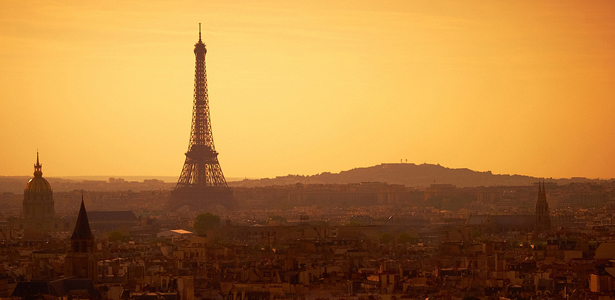
As tourist flavor here in Paris winds to a close and the air in one case again becomes crisp, fresh, and new, we must unfortunately acknowledge that it does not end without a few casualties. Yes, this summer, like the ones that have come before it, has claimed at least 20 victims of a very particular affliction: Paris Syndrome. And though information technology may sound like a affliction unique to freshman girls with Le Conversation Noir posters everywhere, it is a serious disorder that causes tourists, especially Japanese tourists, many problems on their trip through the Urban center of Light. And what is Paris Syndrome, exactly? Simply put, it's a drove of physical and psychological symptoms experienced by first-time visitors realizing that Paris isn't, in fact, what they thought information technology would be.
Information technology is no cloak-and-dagger that the representation of Paris in amusement is a limited one. If the subject area matter even makes information technology past the World War Two era, ane is still commonly going to get a adequately idealized film. Watching movies gear up in Paris leaves one with an paradigm of the urban center that is quaint, friendly, affluent, and probable however in black-and-white. When we use Paris in advertisements, it is invariably some non-threateningly attractive young woman riding a wheel around the side streets or skipping downward the Champs-Elysées, daintily nibbling a macaroon. Nosotros imagine the whole urban center just smells like Chanel No. 5 and has a government-mandated mime on every corner. And nowhere is this narrow view of Paris more prevalent than in Nippon, where the media portrays the city as one filled with thin, gorgeous, unbelievably rich citizens. The iii stops of a Parisian's twenty-four hour period, co-ordinate to the Japanese media, are a buffet, the Eiffel Belfry, and Louis Vuitton.
Even so, despite our international want to imagine that this is a city where pigeons stay in the parks and the waiters occasionally burst into song, Paris can be a harsh place. Information technology has its share of social problems: crime, filth, inequality, and -- our special care for for the visitors -- non-so-friendly locals. Parisians are constantly breaking new scientific footing when it comes to being unaccommodating and fifty-fifty disdainful towards foreigners. If you do non speak French, y'all can look forward to stumbling through many uncomfortable, labored conversations with people who resent your very being. The service industry, too, is notorious for treating tourists like something they recently scraped from the bottom of their shoes. Even the public transportation, instead of being the jolly metro cars in antique underground stations we see in films, are hot, overcrowded carriages filled with groping couples, screaming children, and unimaginably loud squeeze box music.
And while this does non stop Paris from being a wonderful, beautiful city -- every city has its pros and cons -- the fact that its downsides are wiped so institutionally clean from the media isn't doing it any favors. Unlike New York, which embraces its gritty underbelly in its public image -- "Hey, you might become shot walking to the post office, just that'southward what makes it fun!" -- the world seems determined to represent Paris as perpetually spinning inside a lilliputian girl's music box. This disparity between what nosotros run into and what we go hits tourists, and it hits some of them very hard.
Paris Syndrome manifests itself differently in dissimilar people, simply among the most common symptoms are acute delusions, hallucinations, dizziness, sweating, and feelings of persecution. The shock of coming to grips with a metropolis that is indifferent to their presence and looks nothing like their imagination launches tourists into a psychological tailspin which, in at least vi cases this year, necessitated the patient being flown back to his or her country under medical supervision. Usually, though, bed residuum and hydration seem to accept care of the problem inside a few days. The Japanese Embassy, though, has had no shortage of people who, in the throes of the Syndrome, call or visit to be reassured that the city is not going to plummet in upon them.
This illness seems to accept taken its place every bit the 21st century gout -- just slightly as well privileged a problem to empathize with. One imagines women with large, ornate folding fans fainting on street corners and mustachioed men's monocles dropping, with a little tinkle, into champagne glasses. However, for those who succumb to it, Paris Syndrome and its after-effects are very, very existent. Sufferers have reported being traumatized by the experience, of fearing always traveling again.
Only what is the city to do about it? Should they accept that at that place is an bodily medical status associated with how much of a disappointment Paris can be? Should they encompass the take chances? Even if they went that route, what PR house would be capable of turning "some people are hospitalized from how scary and mean our city turns out to be" into "Paris: But the strong survive"? No, it is in Paris' all-time interest to go along feeding into the rose-colored glasses the world seems and then ready to come across it through. Paris tourism only climbs with every Amélie, or Dior perfume commercial directed by Sofia Coppola. Last summer, the image all over Paris' tourism brochures was a gorgeous model with a small Eiffel Belfry strapped to her forehead with reddish, white, and blue ribbon. She was, literally, a Gallic unicorn. That is how far their delightful, twee trivial presentation has been taken.
So how tin tourists prepare themselves for the Urban center of Light, and avoid being rushed home with a doctor on an emergency flight dorsum to their homeland? If repeated viewings of La Haine and Taken are not highly-seasoned, and all-encompassing reading on the 2005 suburb riots would crave likewise much fourth dimension on Wikipedia, they could always just remind themselves of the realities of the urban center they're so excited to visit. They could remember that obesity is a growing problem in France, that McDonald'due south, KFC, and Subway are popping up like acne all over the city, and that pickpocketing and mugging are some of the nearly common crimes in the area. They can retrieve that, despite how beautiful the lord's day is setting backside the Eiffel Belfry, at the base of operations of the structure, there are sure to be hundreds of pushy men screaming at you to buy their i-Euro trinkets. They can remember that it is not a tipping culture here, servers are getting paid the same amount either way, so their attitude towards y'all will depend solely on how nice you are willing to be to them. The customer is non always correct -- he simply exists. That is as far as the Parisian waiter is willing to take it.
With these things in mind to rest out a shoebox full of Doisneau's nigh mannerly photos, ane tin can expect a Paris that meets the reasonable portrait in one's imagination. The city will be dingy, crowded, loud, and indifferent -- but it will be beautiful and breathtaking. And every bit long as 1 does not wait the article of furniture to spring to life and help you go set up for your dance with the Fauna, a trip to this city will exist fulfilling, exciting, and, most importantly, free of debilitating hallucinations.
Image: Moyan Brenn/Flickr.
Source: https://www.theatlantic.com/health/archive/2011/10/paris-syndrome-a-first-class-problem-for-a-first-class-vacation/246743/
0 Response to "Paris Syndrome and Other Travel Phenomena You Didnt Know Existed"
Post a Comment