Hs2 Plan and Profile Drawings

Published
16th September 2020Knowledge Blazon
Technical paperOf Involvement To
Consultants Contractors Engineers Leadership teams Other Individual sector clients Professionals Project Managers Public sector clients ResearchersHS2 track alignment change process through collaboration
Context
This paper focuses on the southern section of High Speed 2 (HS2) Phase Ane – Lots S1 and S2 (Surface area South) –including the Northolt Tunnels and the Euston Tunnel and Approaches, being delivered by the SCS Integrated Project Team (IPT).
The Projection Principal Alignment (PMA) is the HS2 alignment that integrates all new developments in an bodacious manner and is managed and controlled past HS2 Ltd, the ultimate owner of the infrastructure. This ensures a single source of truth and the coordination of all contracts and design packages of the HS2 Project. Every change proposed by whatsoever of the intervening parties and then follows the Route Development Procedure and is finally consolidated in a Course C. Following its revision and approval, the proposal is integrated in an updated version of the HS2 PMA and shared back with the dissimilar contract representatives.
A consolidated PMA was provided to all the Primary Works Civils Contractors at scheme design. This combined all component parts of the alignment for all lots within the HS2 Project and was the initial reference to piece of work from.
Design House (DH) (part of the SCS IPT) mobilised a Route Civils team to support SCS on the alignment development for Lots S1 and S2. The starting time job they adult, afterward thoroughly reviewing the reference pattern, was to undertake value engineering, initiated in September 2017. Construction teams and design disciplines participated in the identification and development of new opportunities to bring value to the project.
Following the optioneering process, and once the sifting outcomes were confirmed for all options under assessment, a new alignment was developed and information technology informed all the assets along the route.
HS2 actively participated in the process, cogent a change on how engineering tin be undertaken, with a fully collaborative approach. The final product of the aforementioned process was a offset version of the alignment Form C[1],[2](July 2018), requesting a modify to consolidate the value engineering practise.
Scheme Blueprint progressed based on the newly created Grade C[1],[ii] till, one time the scheme was finished in Autumn 2018, a new scenario loomed where further opportunities were identified prior to progress to the detail blueprint and construction phase. Alignment was a key to realise those opportunities. The challenge was – how to speed upward a procedure that previously took eighteen months, now with only a third of that period bachelor, and non to jeopardise the construction plan.
A collaborative arroyo was then promoted, and an integrated working group composed of HS2 alignment representatives, SCS Pattern Management and DH was created. This group jointly develop solutions proactively, setting upwardly fortnightly command sessions to develop the Alignment Options Reports[3],[iv],[5] and ultimately the final Class C[one],[two] (July 2019) that covered all changes promoted past the Integrated Project Leadership Squad (IPLT) and enabled the project to progress fulfilling all parties' requirements.
From then onwards, and learning from the arroyo undertaken during 2019, the alignment, typically a rigid element of the blueprint, has been able to rapidly suit to arising challenges and opportunities, and efficiently take advantage of them when required.
The project currently is based on an updated and consolidated alignment that will exist the ane that constitutes the ground for the construction and functioning of HS2. The timeline of the process is shown in figure 1.

Scheme pattern – understanding
In guild to accept advantage of the opportunities an Early Contractor Involvement (ECI) contract could offer, an Integrated Project Team (IPT) (DH, SCS and HS2) started to work together through an optioneering procedure, initiated in September 2017.
In Figure two below, each column represents an asset that underwent an optioneering procedure itself. Some of the value engineering science exercises performed on an asset in isolation had repercussions on the alignment. An example of this cantankerous-touch was the implementation of a central shaft increasing the altitude between bores and thus, requiring a horizontal alignment change.
Also in Figure 2, each row represents fourth dimension, starting with a brainstorming session. A sift was so conducted and with the remaining options an integration workshop was held. The intention of that session was to consolidate the optioneering of the alignment together with the changes that were promoted from the assets individually.

The master ideas generated during the brainstorming menses were around diverse themes which included looking at all vertical and horizontal obstructions to written report further options of modifying the alignment in compliance with the HS2 Technical Standards and improve the Euston throat and Northolt tunnel designs likewise as minimising the separation between tunnels.
A start sift confirmed compliance and assurance of the solutions brainstormed and discarded the non-compliances. Compliance checks were undertaken as shown in Figure 3, in line with HS2 Road Development Procedure [half-dozen].

Alignment was used every bit an integration tool forth the whole scheme, becoming an balls cheque process. This integration practise, conducted jointly by SCS construction, HS2 and DH representatives, enabled the project to progress towards the final sift and finally with the alignment that informed the Scheme Design and was defined in detail in the first alignment Class C [1], [2] issued in Summer 2018.
As a summary, the most relevant alignment changes consolidated during the Scheme Design were:
- Euston Throat – Cave realignment (S1)
- Reassessment of vertical alignment / obstructions (S1 and S2)
- Minimisation of separation between tunnels (S1 and S2)
- Horizontal alignment changes to arrange the shafts horizontal fans solution (S1)
Rethinking the scheme design. Active collaboration
Once the Scheme Blueprint was closed, the project progressed into a stage where further opportunities were identified, with the alignment at the core of every decision to brand the technology changes work holistically.
Through critical review of the design balls process to maximise the benefit of our co-located strategy (aforementioned team, same office), a fully interactive approach was undertaken. This arroyo went a pace further compared to the previous phase; An Alignment Working Group (AWG) composed by HS2 alignment representatives, SCS and DH design direction was conformed to ensure the chief opportunities promoted by the IPLT were assured and progressed.
The main alignment changes within this stage related to the evolution of new solutions for certain assets. One time a specific opportunity was canonical past the IPLT, it was discussed and reviewed past the AWG and so the alignment integrated it if the resolution was favourable. Ultimately, the alignment acted as a final sift of all IPLT promoted opportunities to ensure compliance and its suitability (run across Effigy 4 beneath):

The main sources of modify during this period were:
- Opportunities (GW5 and GW6, depending on the IPLT identification period).
- Incorporation of changes generated by the next lots (S3 and C1).
- Update to new set of HS2 Standards and implementation of EDC-076 (Engineering Blueprint Change) specifically including the consideration of "passive provision for a perturbation crossover between West Ruislip Portal and Colne Valley Viaduct".
- GI / Obstructions improvements and overall hazard reduction.

In one case the review procedure took identify, Alignment Options Reports[3], [four], [v] were developed to collect all decisions made to date and informed the cosmos of a revised Form C [1], [2] that was subject of HS2 subject thing experts' (SME) review and acceptance.
To enhance the communication with other HS2's disciplines not co-located with SCS (operations, maintenance, systems), the AWG presented in May 2019 all the changes under evolution to seek acceptance and ensure a directly line of communication, streamlining the decision making process and fugitive unexpected surprises in one case the formal documentation was transmitted to the relevant approving body.
The AWG was a central that enabled an agile and versatile direction of the changes improving the way the squad had been working during the previous stages by learning from it. It constituted a useful tool that helped the IPLT decisions to be implemented on fourth dimension ensuring compliance with HS2 standards and the cosmos of a strong communication strategy beyond the project.
The Route Development Procedure [half-dozen] (RDP) was applied during the process resulting in a Form C [1], [2] by the end of July 2019. Run into Figure six.

Some of the main opportunities that were successfully implemented in the period were:
- Increased clearance to Thames Lee Tunnel and Adelaide Ventilation Shaft civil works depth reduction (See Figure vii, where the green line represents the consolidated option).

- New Tunnel Ventilation Strategy Implementation (redesign of S2 Ventilation Shafts) with an alignment impact (see Figure 8).

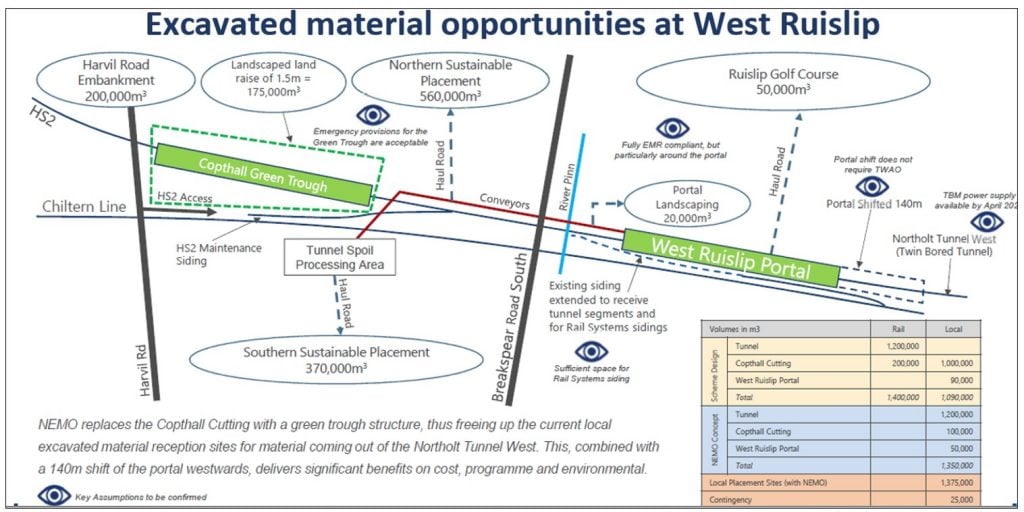
- New excavated textile opportunities, including a Portal Shift, heighten of vertical profile and the siding close to the Chiltern Line realignment. See Effigy ix.
Final alignment course C
The final alignment Grade C [one],[2] of July 2019 (version C03 of the Form C documents [1], [ii]) incorporated all track alignment refinements canonical by the IPLT as described in the previous section. Since then, this Class C has constituted the footing of the assets civil design for both S1 and S2 HS2 Stage Ane lots.
This concluding Grade C collates a broad range of documents in order to testify that the rails alignment design complies with HS2 Technical Standards applicable to this specific project:
- Schedule of TADS (Technical Standard – Track Alignment Blueprint [vii]. Infrequent Values and Non-Compliances, a comparing betwixt the baseline option for the rail alignment and the proposed modify, based on non-compliant and infrequent values.
- Alignment Pattern Change Report (ADCR), including a designer's log with central decisions for the change as well as new risks and assumptions associated with the proposed change. This document records both interdisciplinary and interface consultations including a summary of high-level impacts.
- Designer Geometry Bank check Sheet and Summary of Changes, where the occurrence of new not-compliant and unavoidable exceptional values is recorded.
- Plan Contour and obstruction drawings, supporting plan and profile drawings which include both the baseline option and proposed rail alignment change. A graphic comparison for a better agreement.
- 3D models and the alignment file, the main alignment tools that will be part of the future HS2 PMAs.
These documents are focused on the alignment merely but do not compile all aspects related to the change assessment as a whole. That was the starting point of the Alignment Options Reports, which were included in the projection to provide a structured and evidenced approach of the changes. Options Reports summarise merits and weaknesses, for all disciplines, of all studied options and confronting the baseline option as developed and reviewed by the AWG.
Farther refinements
That version of the alignment Course C is considered the ground of the civil design since July 2019. Yet, the integrated project team has developed further opportunities to de-run a risk or improve the scheme when it was viable. The incorporation of an alignment alter at Greenpark Way Ventilation Shaft into the HS2 Project Chief Alignment (PMA) is a good example of this.
Greenpark change is the effect of an appointment process carried out on the evolution of different opportunities where blueprint, construction and operation & maintenance disciplines were involved following the successful example gear up by the AWG in 2019.
The design change procedure finalised with a Articulation Engineering change Panel (ECP), session where the possibility of sifting the alignment by 4m northwards was put forward in order to reduce the risk on the operation of the Network Rail Chiltern lines, running adjacent and parallel to the south of the HS2 alignment.
In addition to that, clear benefits in terms of health and condom, temporary works rationalisation, drilling and footing movement reduction were the main drivers for the ECP to back up this alignment refinement.
The benefits of the alter were clear merely its integration in a new alignment iteration was challenging. With on-going detail design for most of the assets underway forth the S1 and S2 scheme, the alignment had to be modified mitigating knock-on impacts on other elements of the blueprint and complying with HS2 Technical Standards. See Figure 10.

Greenpark alignment change was carried out with the back up of HS2 specialists following the Route Development Procedure [6]. This provided an informed conclusion on the alignment design pick the project should progress with. Every bit a result of that collaborative work, the initial alignment for Greenpark underwent farther refinements until a last proposal was agreed by all parties. The issue was the Greenpark Alignment Class C [2].
The newest alignment Class C was backed by a new Alignment Options Written report [8]. In that case, the study collated all decisions fabricated related to the new alignment change.
The ECP meeting gave all parties involved the confidence that a satisfactory pattern could be achieved. A collaborative practise carried out by a multidisciplinary team that has concluded up in an improvement of the one-time design.
Conclusions and lessons learnt
The principal focus of this paper is not to demonstrate the thorough engineering and technical piece of work undertaken behind the scenes, but an approach to collaboration that if properly managed could bring lean and integrated direction practices to future projects.
It is all most a learning curve. It has been presented how SCS and DH started to work together during the Scheme Design, how a single squad was set in movement sharing a mutual vision and objectives, which was continued during the opportunities implementation phase after on. Finally, a further demonstration of the constructive collaboration is the straight implementation of a alter at Greenpark Ventilation Shaft. A task that could accept taken a long time at the early stages of the contract was performed in a short flow of time post-obit an assured, transparent and consistent process.
Throughout the process we have learned how to work collaboratively in an ECI surroundings, with a seamless blueprint, construction and HS2/operations integrated project team sharing objectives and actively participating in a process that has been beneficial for the projection as a whole.
Collaboration is the key in applied science of the future, we are stronger together, and by bringing out the best from each and every discipline and organisation, with a proactive mental attitude and an integrated approach, future engineering science projects cannot exist but successful leaving an enduring legacy for generations to come up.
Acknowledgements
Bryan Todhunter (HS2), for his understanding and support throughout the process, ensuring HS2´southward visibility and contribution to the procedure.
Carlos Gomez Milder (DH), for his support and productive participation in the alignment evolution from day one on behalf of DH leadership team.
Tom Beales-Ferguson (DH), for his continuous support to the Route Civils squad ensuring impact on third party assets was at the core of every decision and for his coordination role, key to ensure consistency between the alignment and GMAs (Ground Movement Assessments) development.
References
[1] 1MC03-SCJ-RT-FRM-S001-000002, Alignment Course C – Alignment Design Change Study (ADCR) – S1.
[ii] 1MC04-SCJ-RT-FRM-S002-000002, Alignment Course C – Alignment Blueprint Change Study (ADCR) – S2.
[3] 1MC03-SCJ-RT-REP-S001-000004, Alignment Options Study S1.
[4] 1MC04-SCJ_SDH-RT-REP-S002-000001, Alignment Options Report – Northolt Tunnels S2.
[5] 1MC04-SCJ_SDH-RT-REP-SS05_SL07-000001, Alignment Options Report – West Ruislip Area Structures S2.
[vi] HS2-HS2-SA-PRO-000-000007, Route Development Process.
[7] HS2-HS2-RT-STD-000-000001, Technical Standard – Rail Alignment Design Standard.
[8] 1MC04-SCJ_SDH-RT-REP-SS05_SL06-000001, Alignment Selection Study – Greenpark Way Vent Shaft S2.
These materials, courtesy of HS2 Ltd, are delivered past an API protocol directly from the HS2 Learning Legacy website

What We Offer
Source: https://majorprojects.org/resources/excellence-through-collaboration-alignment-change-process-2/
0 Response to "Hs2 Plan and Profile Drawings"
Post a Comment